Build log Part 0
Why I built FeedPia
I set out to take some strain off my parents' shop, and ended up building something for the moment before you approve what an AI agent wants to do.
FeedPia builds technology that lets you see what follows a choice before you make it. I started writing code in 2023. This is how that led to OLP (Outcome Lookahead Protocol), which goes public on Nov 8. OLP is an open protocol, first built as a hook (a small add-on that runs before a command) for Claude Code, an AI coding agent. It shows what will change right before the agent deletes files.
2023
Code looked like the real world
Once I started programming, the way code runs looked a lot like the way the real world works. That pulled me into physics, philosophy and computer science.
Many tools, one way of working
I moved between editors like Cursor, VS Code and JetBrains, and between models like Gemini, Claude and Grok. Bit by bit I settled into a routine: hand the AI a task, write the rules down, then check the results. Only later did I learn that people call this a harness. At the time I was doing it without a name for it. I still build alone, with AI's help.
From one shop on one screen to OLP
The first thing I built was a dashboard that put a whole shop on one screen. A few earlier tools followed it. That road, which began with easing strain on my parents' shop, led to the moment before you approve what an AI agent wants to do. OLP is what I built there. It shows what an action will change before an AI agent runs it.
What came back
I described this road to investors: from the shop dashboard through the earlier tools to OLP.
Here is what came back.
"This is crazy."
"Do what makes money first."
"It's not worth investing in."
"Build what people want."
"It's science fiction."
The remarks came back one by one, and I carried them into the next day and kept building. Alone, with AI.
One test in a practice folder
So I kept building. On Nov 2, in a practice folder, I saw this. I asked Claude Code, in auto mode, to delete a folder. (Auto mode means a separate AI screens each command and lets ordinary work through without asking you to approve it.) The AI said it deleted 2 files. Three were gone. The agent had counted only the files git had on record, and missed one that git had never recorded.
When a permission prompt, the pop-up that asks you to approve an action, does appear, I usually click allow before I've finished reading it. That day no prompt appeared at all. There was nothing to click. I wrote up that scene separately in a Threads post.
What OLP 0.1.0 does
OLP 0.1.0 is that hook. Right before an agent deletes or overwrites files, it shows a card with the names and the count. When a card appears, the choice to continue or stop is the person's. The card only adds the facts for that choice.
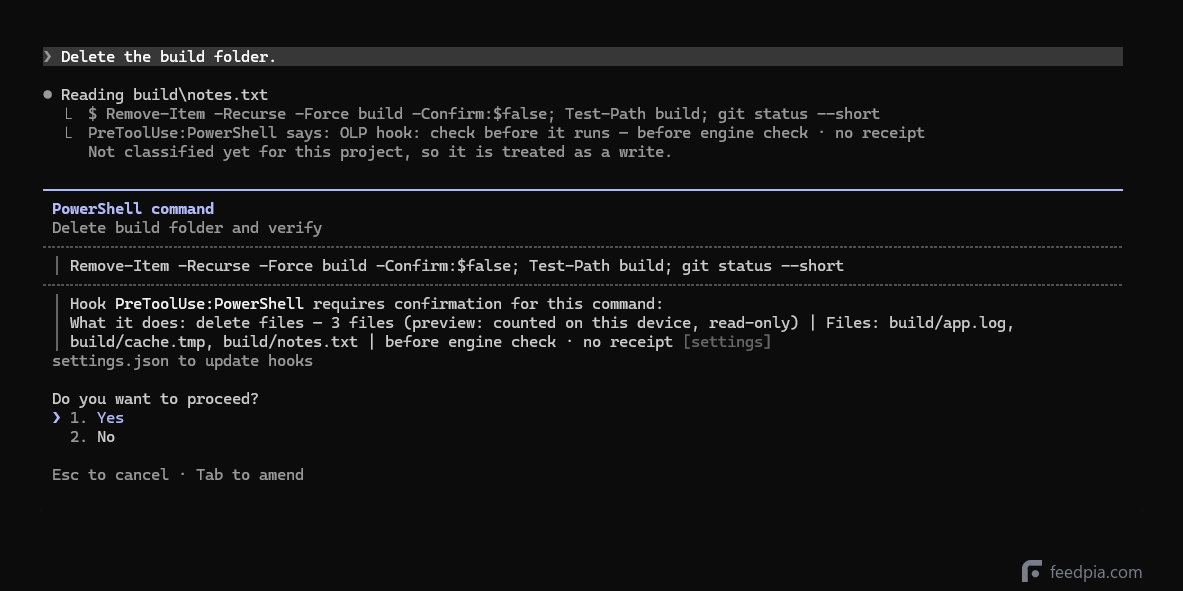
I ran the same test twice with OLP on. Nobody was watching either run, and both times OLP stopped before the delete and showed all three file names. Nothing was deleted. I confirmed the result in the log. I also ran the test twice without OLP: on Nov 2 the agent said 2 files, and on Nov 4 it said 3, correctly. Why it differed is not in the record.
What is still missing
- OLP still shows its card before commands it doesn't recognize yet, even read-only ones.
- On slow Windows PCs, it may ask more often.
- The card is in English only.
- It doesn't check whether a deleted file can be restored.
- I ran the test only twice without OLP and twice with it.
From Nov 8
OLP 0.1.0 will be free and open source from Nov 8. No signup is needed, and install and undo steps are in the README. The next post will record the rules I corrected, with dates.
When your agent says "done," what do you check?